MHealthy
team
Hans So, Seorin Jang, Yiting Wen, Wuhao Cao
type of work
UX Research
role
UX Researcher
timeframe
August - December 2025
Closing the feedback loop in workplace wellness by leveraging AI-driven insights and physical touchpoints to ensure equitable program engagement.
MHealthy supports University of Michigan employees through a network of over 500 volunteer "Champions." Our research revealed a critical breakdown: while Champions broadcast wellness initiatives, they lack a way to hear back from their units.
By closing this feedback loop, we transformed the program from a "best-guess" model into a data-driven strategy that protects both employee wellbeing and the university’s financial investment.
As one of the Research Leads in a cross-functional team, I facilitated the data synthesis that transformed over 100 qualitative data points into a cohesive strategy, proving that the 'feedback gap' was a structural issue rather than an isolated problem.
RESEARCH PIVOT
Initial Goal: Increasing Shift Employee Engagement
Our team originally set out to solve for low engagement among shift employees. However, after 6 initial interviews, we hit a wall: we couldn't accurately design for a population whose voice was missing from our data.
The Pivot -
Rather than guessing, we revisited our transcripts and identified a deeper, systemic issue: an incomplete feedback loop. One interview sparked the insight that Champions were operating in the dark.
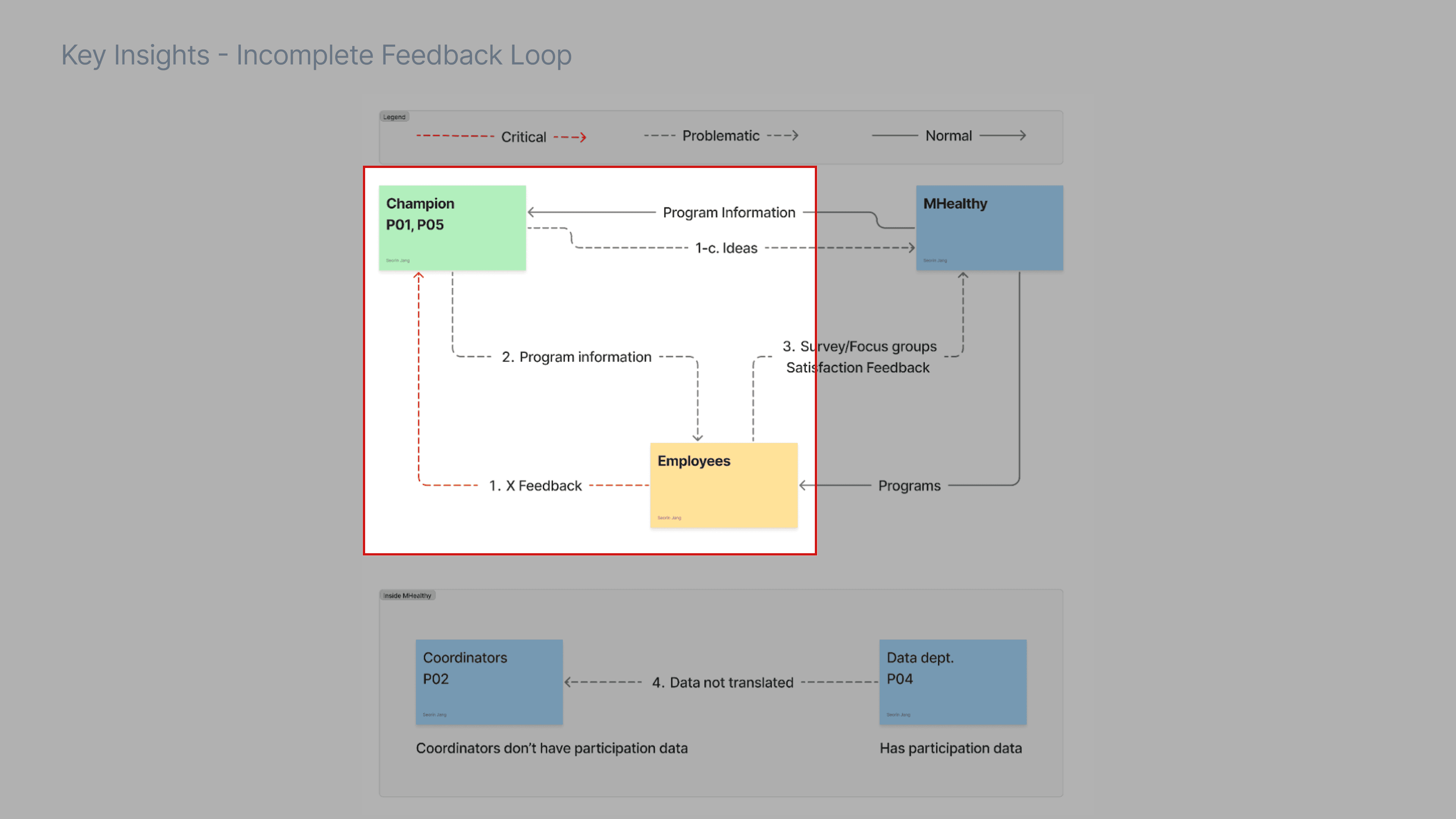
To ensure this wasn't an isolated incident, we conducted an additional 6 targeted interviews specifically focused on the Champion experience.
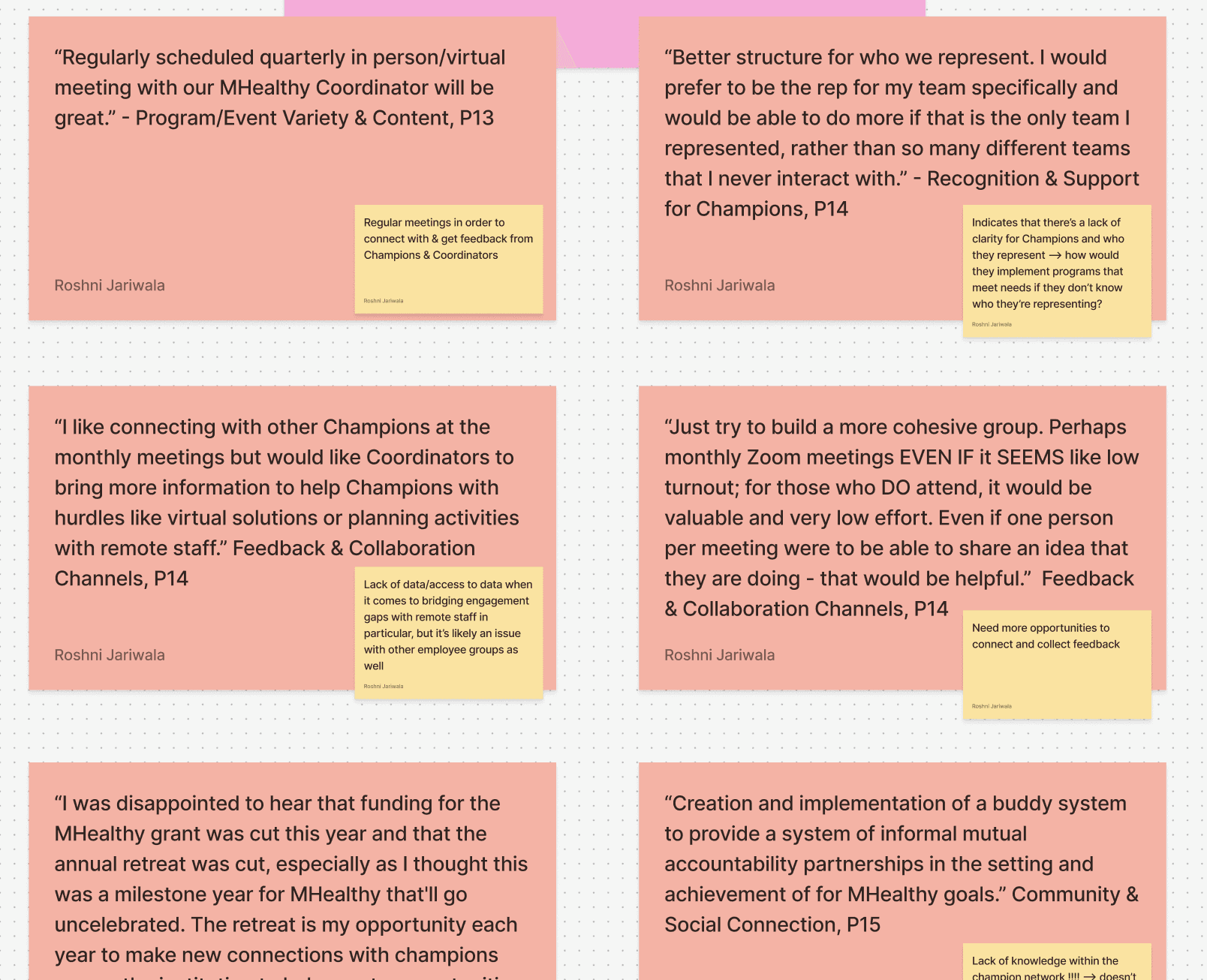
Using an Affinity Map to synthesize 100+ qualitative data points, we confirmed three systemic patterns:
Feedback Flaw: A complete breakdown in bottom-up communication.
Champion Isolation: A lack of infrastructure for volunteers to connect, share resources, or collaborate across campuses.
Systemic Barriers: Built-in obstacles preventing employee participation.
PROBLEM DEFINITION
How might we help MHealthy Champions better understand and meet the needs of the employees they represent?
To close this feedback loop, we developed three strategic recommendations designed to transform Champions from passive messengers into data-informed advocates.
RECOMMENDATIONS
Pain Point: The Information "Black Hole"
Champions are currently forced to guess employee needs. While MHealthy collects robust survey data annually, that information is never shared with Champions within their respective units, leading to guesswork and misaligned initiatives.
Solution: A 3-Step Synthesis Engine
To bridge this gap, we developed a workflow that leverages AI to turn raw institutional data into action:
Anonymize & Organize: Cleaning survey data and participation records for privacy & security.
Synthesize: Feeding data into an LLM (like Claude) with custom prompts to identify department-specific patterns and barriers.
Translate: Converting AI insights into clear, readable advocacy reports for each Champion, specific to their unit.
Impact: From Guessing to Advocacy
Instead of broad assumptions, Champions gain specific insights—such as identifying that shift-related conflicts, not lack of interest, are preventing engagement. This transforms them into data-backed advocates for their units.
RECOMMENDATIONS
Pain Point: Digital Fatigue & Low Response Rates
High email volumes often cause digital feedback requests to be ignored or buried. Our research found that traditional surveys were often perceived as a "chore," preventing Champions from gathering the quick, frequent insights needed to adjust programming in real-time.
Solution: Micro-Feedback Touchpoints
We designed 3 physical strategies to meet employees where they are, transforming feedback into a 10-second interaction:
Tip-Jar Voting: Using tokens to indicate program preferences in common areas.
"This or That" Boards: Interactive grids for quick, visual voting on upcoming initiatives.
Sticky-Note Walls: Designated spaces for anonymous, open-ended suggestions.
Impact: Continuous Data Collection
By reducing the "cost of participation," these tools allow Champions to select and deploy a new question and collection strategy in minutes. This creates a steady stream of fresh, unit-level data without requiring employees to set aside dedicated time to engage.
RECOMMENDATIONS
Pain Point: Champion Isolation
Once a Champion joins the network, they often operate in a vacuum. Our research identified a lack of infrastructure for volunteers to connect or collaborate across University campuses, leading to duplicated efforts and a lack of peer support.
Solution: A Cross-Campus Collaboration Hub
We proposed formalizing a virtual community on an existing institutional platform to facilitate:
Strategy Exchange: A space to share which initiatives worked best in specific units.
Resource Sharing: A central repository for MHealthy assets and marketing templates.
Peer Support: A collective knowledge base that reduces the individual burden on volunteers.
Impact: From Isolated to Integrated
This hub provides the human foundation necessary to sustain the feedback loop. By fostering collaboration, we ensure Champions have the community support needed to act as effective advocates for their units.
THE BOTTOM LINE
Engagement isn't a marketing problem—it’s a structural equity problem. By strengthening the Champion network, we moved MHealthy from guesswork to a data-backed strategy that protects both the university’s budget and its employees.
If we had more time, I would:
Pressure-test the AI: Run the synthesis workflow with a larger dataset from different University units to ensure report accuracy.
Targeted Recruitment: Partner with unit leads to secure dedicated time for interviews with hard-to-reach shift employees.